
Dubai closed 2025 with AED 917 billion in real estate transactions across 270,000+ deals, and 2026 is shaping up to be the most consequential half-year for selective investors in a decade. Here is what the data is telling me, and where we see the real opportunities.
The Market Has Shifted — And That Is a Good Thing
For the past four years, Dubai real estate rewarded almost anyone who showed up. Post-pandemic demand, global wealth migration, and Golden Visa reforms created an extraordinary upward cycle. Prices rose. Yields held. New investors flooded in.
That cycle is maturing. And we say that as a positive, not a warning.
The Dubai Land Department recorded over 44,700 property transactions worth AED 143.1 billion in Q1 2026 alone, a 22% increase in sales value year-on-year. But the nature of who is winning inside that volume is changing fast. The investors who will perform best in H2 2026 are those who understand that this is no longer a market where every postal code rises together. It is a market of specific corridors, specific asset types, and specific timing.
At Karma Developers, we have been building across Dubai since 2013, through slowdowns, through oil price crashes, through a global pandemic. What we are seeing now is a market entering a phase that rewards preparation over momentum-chasing. Let us break down exactly what that means.
Five Things Defining Dubai Real Estate Market in H2-2026
Supply Is Real — But So Is Absorption
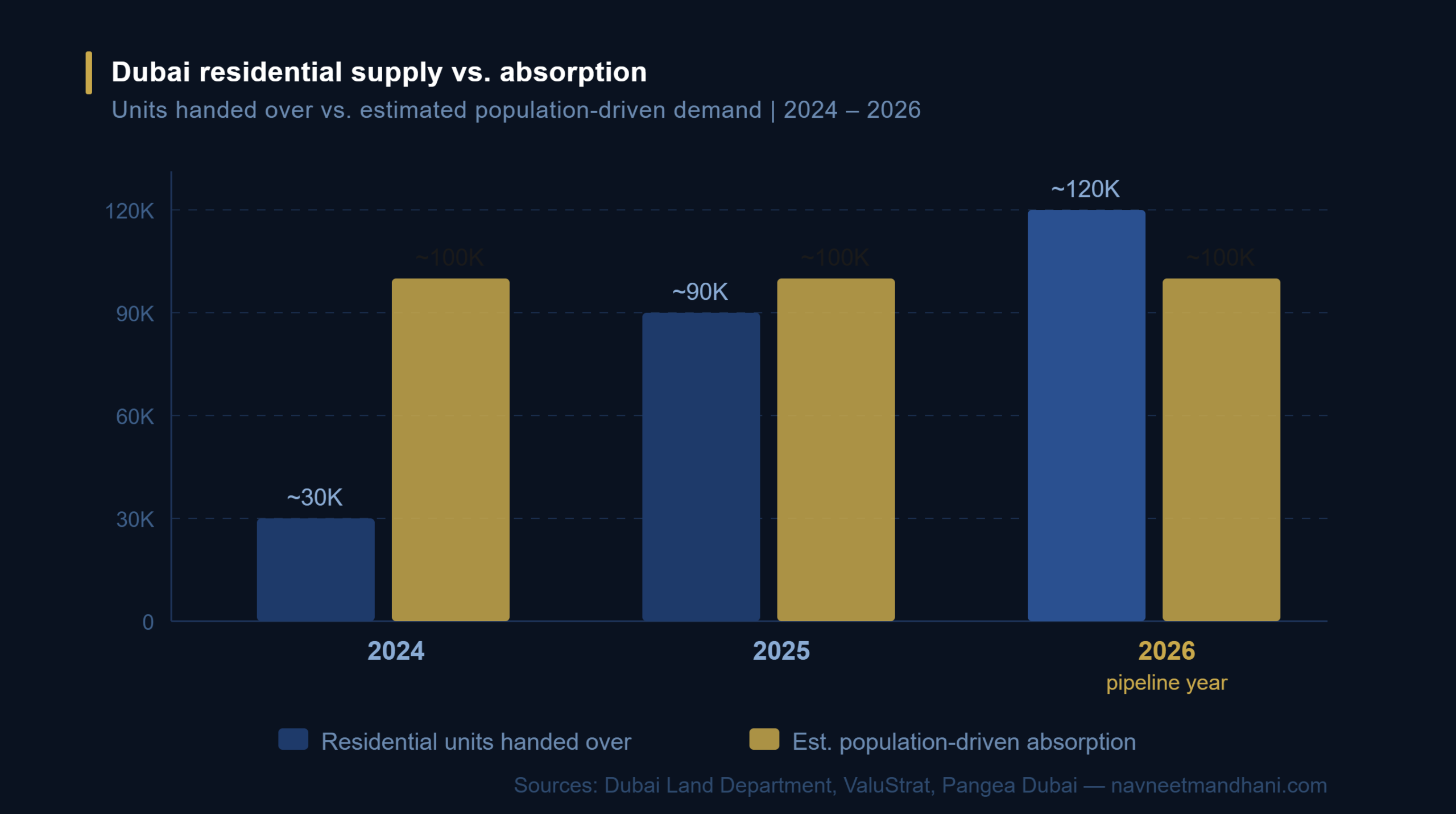
The most-discussed number in the market right now is 120,000 units scheduled for handover in 2026, up from approximately 90,000 in 2025. Analysts at Fitch have pointed to this pipeline as a potential moderating force on prices, with downside scenarios discussed in bearish conditions.
Here is why we are not alarmed, but why we are selective.
Dubai’s population absorbed handovers through 2023 and 2024 even as supply increased, because the city added residents faster than units were delivered. ValuStrat noted that Dubai added 100,000+ residents in 2023 while approximately 50,000 residential units were handed over. The structural demand driver, population growth, business expansion, and international wealth relocation, has not reversed.
What has changed is where the supply lands. The incoming pipeline is concentrated in specific districts. Cavendish Maxwell has noted that while a market-wide oversupply scenario is not anticipated, “clustering could create pockets of absorption pressure, particularly in districts where several phases are delivered simultaneously.”
Investors who understand which micro-markets face that clustering, and which do not, have a significant edge right now.
Villas Continue to Outperform Apartments
ValuStrat’s 2026 outlook projected citywide residential capital values to grow approximately 10%, but with villas appreciating at 17.7%, significantly ahead of the apartment segment.
This gap is not a short-term anomaly. It reflects a structural shift in buyer preference that accelerated post-pandemic and has not reversed: larger living spaces, access to outdoor amenity, LEED-aligned sustainability features, and community design that supports families rather than just accommodating them.
At Karma, we identified this shift early. Projects like Beach House on Palm Jumeirah and The Plaides Villa in Cyprus were built around this thesis: that the premium for thoughtful community design would compound over time. The data continues to validate that.
For investors looking at H2 2026: villa and townhouse product in well-connected corridors, particularly master-planned communities with genuine lifestyle infrastructure, remains the strongest risk-adjusted position.
Off-Plan Is Still Dominant — But Due Diligence Has Never Mattered More
Off-plan properties accounted for more than 67% of all transactions in Q1 2026. That dominance is real, and it reflects rational investor behavior: lower entry prices, staggered payment structures, and the ability to acquire in communities before full infrastructure is priced in.
But the risk profile of off-plan has shifted. With over 120,000 units entering the handover pipeline, delivery timelines and developer track record are no longer secondary considerations — they are the primary ones.
What distinguishes Dubai’s strong off-plan investments in H2 2026
- Developer delivery history: Has this developer actually handed over projects on time, at the quality promised?
- Payment structure liquidity: How does the post-handover payment schedule interact with your cash position?
- Infrastructure timing: Is the surrounding community genuinely built out, or is the developer ahead of roads, retail, and transit?
- Exit liquidity: What does secondary market volume look like in this specific sub-district?
These are not new questions. They are just more consequential now than they were when a rising tide was lifting all boats.
The Commercial Sector Is the Hidden Opportunity
Most of the investor conversation in Dubai focuses on residential. The commercial data tells a more compelling story for 2026.
ValuStrat’s outlook projected office capital values and rental rates to increase by 15%, driven by acute supply-demand imbalance, only approximately 1.6 million square feet of new office supply is scheduled for 2026, against intense and continuing demand.
This mirrors something we have observed directly through our own project pipeline: the business formation rate in Dubai, new companies being set up, regional headquarters being relocated, family offices establishing a presence, is structurally strong. Those businesses need space. The supply is not keeping up.
For investors able to access commercial assets in business-grade corridors, H2 2026 represents an unusual combination: strong yield, capital value appreciation, and long-term lease security.
The Golden Visa Ecosystem Is Compounding Demand
The UAE’s Golden Visa program, which grants 10-year residency to property investors meeting certain thresholds, is not simply a marketing tool. It has created a structurally different buyer: internationally mobile, long-term oriented, and focused on quality over speculation.
The DLD reported that the market attracted 193,100 investors in 2025, up 24% year-on-year, with 56.6% identified as UAE residents. This is not purely speculative foreign capital. It is people building lives here, making long-duration decisions about where they live and how they invest.
That buyer profile demands different product. Not the fastest-built, cheapest-delivered unit in an emerging cluster. Product that delivers on lifestyle, sustainability credentials, and long-term community quality. That is where Karma has positioned every project since 2013, and it is where I believe the safest capital appreciation in H2 2026 resides.
The Micro-Markets Worth Watching
Based on current data, transaction momentum, and infrastructure maturity, these are the corridors we would prioritize research on for H2 2026:
- Dubai Hills Estate, Arabian Ranches, Jumeirah Golf Estates
CBRE and ValuStrat have consistently identified these as demonstrating stronger price resilience than oversupplied apartment-heavy districts. Limited inventory, strong end-user demand, and genuine lifestyle infrastructure. - Dubai South / Expo City corridor
Long-term infrastructure story. The Al Maktoum International Airport expansion underpins a 10-to-20-year demand thesis. Early positioning in this corridor has historically rewarded patient investors. - Dubai Silicon Oasis and surrounding tech corridors
Where we built early at Karma. Professional-grade communities with strong rental yield fundamentals, driven by Dubai’s continuing push to attract technology sector talent and companies. - Jumeirah Village Circle
Remains one of the highest-volume transaction sub-markets in the city. Investor liquidity is real, yields are holding, and the affordability profile attracts consistent tenant demand.
The Question Investors Should Be Asking
The wrong question in H2 2026 is: “Is Dubai real estate still a good investment?”
The AED 143.1 billion transacted in Q1 2026 alone answers that.
The right question is: “Which asset type, in which corridor, from which developer, at which entry point, with which payment structure, creates the best risk-adjusted return for my specific capital horizon?”
That is a more complex question. It requires understanding the supply pipeline at a sub-district level. It requires evaluating developer delivery history. It requires thinking about who the end buyer or tenant is, and whether the macro conditions attracting that buyer are structural or cyclical.
Navneet has spent 13 years building the analytical framework to answer that question, first as an engineer, then across Fortune 500 technology environments, through early-stage investing and exits including Yourkeys.com (acquired by Zoopla), and now across a multi-billion dirham development pipeline.
The investors who approach H2 2026 with that rigor will find it one of the most rewarding periods Dubai real estate has offered in a decade. The investors who chase the headline without doing the work will find the pockets of absorption pressure that Cavendish Maxwell warned about.
Final Thought
Dubai is not a boom-and-bust story anymore. It is a maturing global city with real infrastructure, real population growth, real economic diversification, and real institutional investor participation. The AED 21 billion transacted in a single week in May 2026, even during a period of regional geopolitical uncertainty, tells you everything about the depth of underlying demand.
H2 2026 is a market that rewards expertise over enthusiasm. If you are doing your research, understanding the micro-market dynamics, and working with developers who have demonstrated delivery discipline over a decade, there is significant value to be captured right now.
If you want to discuss where we see the most compelling positioning for your specific investment profile, we are always happy to talk.

Recognition at the 2026 MENA Stevie Awards – Silver & Bronze