
Most advice on how to build a company or a resilient business is written by people who have only ever run one company, in one sector, through one cycle. Mine has moved through three: telecommunications, commodities and shipping, and now real estate development. I have watched a business I built go from zero to exit, and I have watched a real estate company scale past a $1.3 billion project pipeline while the market around it went through at least two full corrections. None of that happened because I predicted the cycles correctly. It happened because the businesses were built to survive being wrong about the timing.
That distinction matters more than most founders admit. You cannot forecast a downturn with any precision, and you should stop trying. What you can do is build a company that does not depend on being right about what happens next. Here is what that has actually looked like, across three very different industries.
Why Most Companies Don’t Survive a Full Market Cycle
A business rarely fails the moment a downturn hits. It fails in the eighteen months before, when growth was good enough that nobody asked the uncomfortable questions: what happens if this single revenue line halves, what happens if this one lender pulls back, what happens if this one market stalls. Building a resilient business starts by asking those questions while the answers are still cheap to fix, not after they’ve become the only thing anyone is talking about.
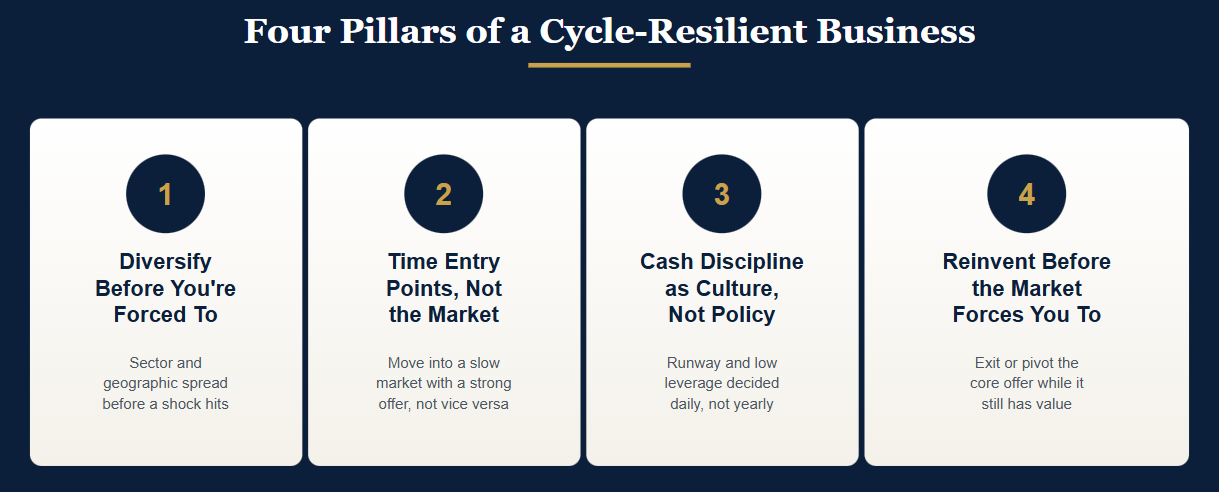
Diversify Before You’re Forced To
I founded Voyzze Communications, a VoIP company in North America, in 2010, and exited it in 2013, the same year I founded Karma Developers in Dubai. That was not a planned “pivot to real estate.” It was one instance of a pattern I’ve repeated since: don’t wait until a sector turns before you have a foothold somewhere else.
Karma Developers has followed the same logic geographically. What started as a single freehold development in Deira expanded into the UK, Cyprus, and Romania, and more recently into commercial development in Dubai with a large landholding in Dubai Investments Park. No single city, asset class, or buyer segment carries the whole business. When one geography slows — and in real estate, something is always slowing somewhere — the group isn’t waiting on that one market to recover before revenue moves again.
Time Entry Points, Not the Market
You cannot time a market cycle. You can time where you enter within it. Karma’s early projects were placed in Dubai Investments Park, Falcon City, and Dubai Silicon Oasis — areas that were overlooked during a market slowdown, not areas everyone else was already competing over. The company wasn’t betting the market would turn quickly. It was betting that a well-positioned, well-priced project would sell regardless of when the turn came, because the demand for accessible, design-led housing doesn’t disappear in a downturn — it just gets pickier about who it buys from.
That’s the real skill in building a resilient business: not predicting the recovery, but making sure your offer is strong enough that you don’t need to.
Treat Cash Discipline as a Culture, Not a Policy
Financial prudence gets written into strategy decks and then quietly ignored the moment growth accelerates. It has to be a daily habit inside a company, not a slide reviewed once a quarter. That means real limits on leverage, real scrutiny before adding fixed costs, and a bias toward funding growth from completed, cash-generative work rather than from the next round or the next launch. It is the least glamorous part of resilience and the part that actually determines who is still standing when a cycle turns.
Reinvent the Core Offer Before the Market Forces You To
Beyond building Karma, I’ve spent the last decade as an active investor in PropTech, DeepTech, and AI-focused startups — including early backing of Yourkeys.com, which was later acquired by Zoopla. That investing lens exists for a reason: a real estate business that only ever sells the same product the same way eventually gets disrupted by someone who doesn’t. Reinvention isn’t a crisis response. It’s something you fund continuously, in parallel with the core business, so that when the market does shift, you’re not improvising — you already have the next version of the offer half-built.
Build Trust That Outlasts Any Single Product Cycle
A project can underperform for reasons that have nothing to do with the company behind it — interest rates, currency, geopolitics. What determines whether a buyer, investor, or partner sticks around through that isn’t the specific unit or the specific fund. It’s whether they trust the people running the business. That trust is built slowly, through consistent delivery, transparent reporting, and a track record that’s visible outside your own marketing, through independent recognition, completed projects, and repeat relationships with partners and investors. It is, in the truest sense, the only asset that compounds across every cycle rather than resetting with each one.
Explore more on Karma Developers‘ approach to building resilient, design-led developments, or get in touch via the contact page to discuss partnership and investment opportunities.
Frequently Asked Questions
What does it actually mean for a business to be “resilient” across market cycles?
A resilient business isn’t one that avoids downturns — no company does. It’s one whose revenue, cost base, and leadership decisions don’t depend on a single market, sector, or funding source staying favorable. When one input weakens, the business has other levers to pull instead of a single point of failure.
How do you start building a resilient business if you’re still a single-product company?
Start with the questions, not the diversification. Identify the one input your revenue depends on most — one client type, one region, one channel — and ask what happens if it disappears for a year. That exercise, done honestly, tells you exactly where to diversify first, rather than diversifying broadly and diluting focus.
Why do most businesses struggle during a downturn even when the underlying demand hasn’t disappeared?
Because the growth years often masked concentration risk — in one market, one lender relationship, or one customer segment — that never got addressed while things were easy. The downturn doesn’t create the weakness; it just removes the cover that fast growth had been providing.
Is diversification always the right answer for resilience?
No — diversification without focus creates its own fragility, spreading management attention and capital too thin to execute well anywhere. The goal is deliberate diversification: enough spread that no single shock is fatal, concentrated enough that you can still execute at a high standard in each area.