Two Stevie Awards. 1,400+ nominations evaluated. 155 judges from across the world. I want to be honest about what winning means — and I want to be equally honest about what it does not mean, and what it now demands.
In May 2026, the 7th annual MENA Stevie Awards announced its winners from more than 1,400 nominations submitted by organizations and individuals across 15 countries. I was among them — awarded a Silver Stevie for Most Innovative Leader of the Year and a Bronze Stevie for Innovative Entrepreneur of the Year.
I want to write about this recognition honestly. Not with the language of a press release — which is about broadcasting — but with the language I would use if a founder I respect sat across from me and asked: what does it actually mean when an external body recognizes your work? What do you do with it? And what does it demand of you that you were not already doing?
Those are the questions I want to answer here.
The Recognition
What the 2026 MENA Stevie Awards Are and How They Work
The Middle East and North Africa Stevie Awards is described by its organizers as the only awards program to recognize innovation in the workplace throughout 18 nations in the Middle East and North Africa. The 2026 edition — the 7th annual — was sponsored by the Ras Al Khaimah Chamber of Commerce and Industry, with winners announced in May 2026. The gala ceremony is scheduled for September 11, 2026, at the InterContinental Istanbul in Istanbul, Türkiye.
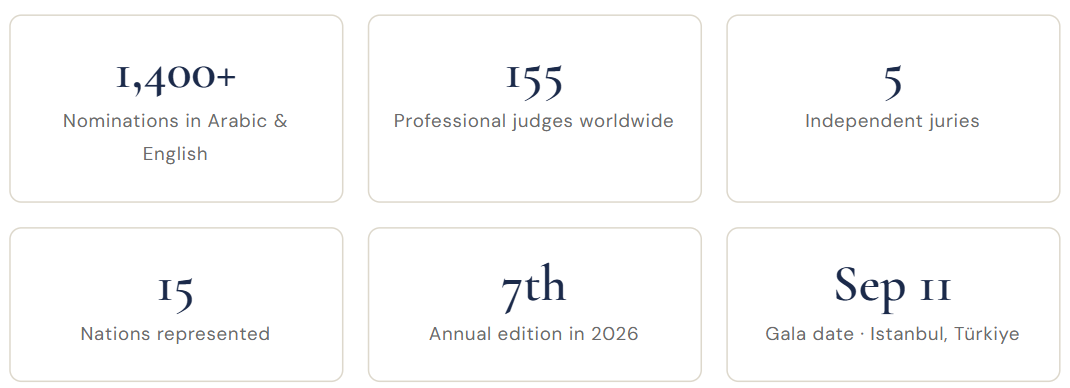
Awards at the MENA Stevies are determined by the average scores of independent judges — not by panel discretion, not by organizational size, not by media profile. Winners were determined by the average scores of 155 professionals worldwide, acting as judges on five juries to recognize achievements across innovation, management, technology, sustainability, thought leadership, and individual professional categories.

The Reflection
What Recognition Actually Means When You Have Been Building for 13 Years
The honest answer is that it means different things to different people at different stages of their career. I want to be specific about what it means to me — a founder who has been building for 13 years across three industries and five countries, and who was not, at any point in that process, building toward a trophy.
What It Confirms
The first and most important thing an award from an independent jury confirms is that the thesis you have been building against has some external coherence — that people outside your organization, who have no reason to validate you and every reason to be critical, looked at the body of work and concluded it met a meaningful bar.
At Karma Developers, the innovation that the Stevie judges evaluated was not a single product feature or a marketing campaign. It was a 13-year commitment to a development thesis that was genuinely contrarian in 2013: that Dubai’s professional class deserved design-quality, sustainability-standard homes at prices they could actually reach. That thesis — maintained through a mid-cycle downturn from 2015 to 2019, through a global pandemic in 2020, and through the extraordinary volatility of 2022 — has now delivered 2,000+ residential units across five countries. The Silver Stevie for Most Innovative Leader does not change any of that. What it does is confirm, through a structured external evaluation, that the approach was coherent and the execution was notable.
“Leadership isn’t about the awards we receive — it’s about the lives we improve through the decisions we make every day.”
What It Does Not Mean
Recognition does not validate future decisions. This is perhaps the most important thing I can say about any award — not just this one. The moment a leader starts making decisions in order to maintain a recognition, or to pursue the next one, they have fundamentally shifted the orientation of their work from building to performing. That shift is subtle and it is dangerous.
I have watched founders who received significant early recognition and subsequently built their next companies for visibility rather than structural value. The pattern is consistent: the companies that followed were often louder and shorter-lived than the first. Recognition-seeking as a founding motivation produces a very specific kind of company — one that is optimised for announcement cycles rather than compounding value.
The reason I can speak about this with some confidence is that the work that was recognized — at Karma Developers, at Sophonos Investments, and through the broader platform of three founder-led businesses — was built entirely without reference to external recognition. The founding principles that have governed every company I have built have never included “be recognised.” They have always been about structural value, long-horizon thinking, and building ahead of cycles.
The Obligation
What Two Stevie Awards Now Demand
The question I find most useful to ask after any recognition is not “what does this mean for my profile?” It is “what does this now demand of me that I was not already delivering?”
For the Most Innovative Leader of the Year recognition specifically, the demand is clear: the standard of innovation at Karma Developers must not plateau because the work has been externally validated. Recognition of a past standard creates an obligation to raise the future one. In practical terms, this means the sustainability integration at Karma — already LEED-aligned — needs to push further into active energy management, community wellness design, and the application of AI to building management systems. The award was for what has been built. The work is about what comes next.
For the Innovative Entrepreneur of the Year recognition: the obligation is visibility. Not personal brand visibility, but the kind of visibility that is useful to other founders — particularly in the MENA region, where the density of capital is not matched by the density of operational knowledge sharing among founders who have actually built at scale. If my experience across four companies and three industries over 20+ years is genuinely valuable, the obligation of being recognized for it is to make it accessible. This blog, the writing I do through the Forbes Business Council, the mentoring I do through my network — these are the expressions of that obligation.
The Wider Picture
What the MENA Stevie Awards Represent for the Region’s Business Community
The Stevie Awards are a genuinely global standard — not a regional vanity exercise. The program was founded in the United States in 2002 and has expanded to produce American Business Awards, International Business Awards, and regional editions including the Middle East and North Africa Stevies. When Stevie Awards President Maggie Miller described the 2026 nominations as “exceptional” and noted the “vast amount of innovation taking place throughout the MENA region,” she was speaking to something real in the data: more than 1,400 nominations from 15 countries reflects a business community that is increasingly willing to submit its work to rigorous, externally evaluated standards rather than self-assessed ones.
This matters for the region as a whole. The credibility of any award is a function of the rigor of the evaluation and the seriousness of the field. When the same program recognizes Karma Developers’ leadership alongside major institutions from Saudi Arabia, Egypt, Turkey, and across the Gulf, the recognition carries weight precisely because the comparison set is serious.
The full list of 2026 Gold, Silver, and Bronze winners is publicly available at MENA.StevieAwards.com.
2026 MENA Stevie Awards — Questions Answered
What did Navneet Mandhani win at the 2026 MENA Stevie Awards?
Navneet Mandhani won two awards at the 7th annual Middle East and North Africa Stevie Awards in 2026: a Silver Stevie Award for Most Innovative Leader of the Year and a Bronze Stevie Award for Innovative Entrepreneur of the Year. Both are Individual Professional Awards categories. Winners were determined by the average scores of 155 professionals worldwide across five independent juries, evaluating more than 1,400 nominations in Arabic and English from 15 nations.
What is the MENA Stevie Awards?
The Middle East and North Africa Stevie Awards is the only awards program recognising innovation in the workplace across 18 MENA nations. The 7th annual edition in 2026 was sponsored by the RAK Chamber of Commerce and Industry. More than 1,400 nominations were evaluated by 155 independent professional judges across five juries. Winners are announced in May, with a gala ceremony on September 11, 2026, at the InterContinental Istanbul in Istanbul, Türkiye. The full winners list is at MENA.StevieAwards.com.
When is the 2026 MENA Stevie Awards ceremony?
The 2026 MENA Stevie Awards gala ceremony is scheduled for September 11, 2026, at the InterContinental Istanbul in Istanbul, Türkiye. Winners were announced in May 2026. The full list is available at MENA.StevieAwards.com.
What other awards has Navneet Mandhani received in 2026?
In 2026, following the MENA Stevie Awards, Navneet Mandhani was also recognised with the Cross-Border Real Estate Leader of the Year at the Gulf Business Real Estate Awards 2026; named in Forbes Middle East’s Most Impactful Real Estate Leaders 2026 and as a speaker at the Forbes Middle East Building the Future Summit 2026; named in Gulf Business’ Top 50 Leaders and CEOs of 2026; and ranked #26 in Property News International’s Power 100: Property Leaders 2026. Full recognition profile: navneetmandhani.com/media/