
Four companies. Five countries. Three industries. Twenty-plus years. Looking back across all of it, three things have been present in every company I have founded — from a VoIP startup in North America to an international real estate platform to a $500M+ investment office. These are not lessons I read. They are things I learned through the specific, sometimes expensive experience of building in industries that punish impatience and reward conviction.
I have been asked, with increasing frequency since the Gulf Business and Forbes Middle East recognitions this year, what connects the businesses I have built. It is a fair question. Karma Developers is a real estate company. Sophonos Investments backs technology startups. Future Resources FZE trades commodities across three continents. These do not look like variations on a single theme. But they share more than they appear to — not in sector, but in the logic of why and how they were built.
I want to be precise about what I mean when I say “founding principles.” I do not mean values in the corporate-brochure sense — words like “integrity” or “excellence” that are effectively unfalsifiable and therefore meaningless as strategic guides. I mean decision rules: the specific filters that have governed how I identified each opportunity, how I chose to enter a market, and how I designed the business to compound over time rather than peak early and erode.
There are three of them. Here is what they are — and what they have actually looked like in practice.
Principle One
Build Where Infrastructure, Capital and Technology Intersect
Every company I have built sits at the junction of three forces: physical or logistical infrastructure, capital systems, and emerging technology. This is not a coincidence. It is the single most deliberate strategic choice I make when evaluating a new venture.
The reason is straightforward. When only one of these forces is present, competition is intense and differentiation is thin. A pure technology company without infrastructure is easy to copy — someone can build a comparable product with a comparable team in nine months. A pure infrastructure play without technology is slow and capital-intensive with limited margin expansion. But when all three converge — when technology is applied to physical infrastructure through a disciplined capital structure — the resulting business creates the kind of compounding moat that is genuinely difficult to replicate.
“My focus remains constant: building platforms that identify opportunities where infrastructure, capital and technology intersect to create long-term value.”
What This Has Looked Like Across My Companies
| Karma Developers | Physical infrastructure (residential communities), capital discipline (affordable luxury pricing, LEED-standard construction economics), and technology (sustainable building systems, smart community design). The intersection is where you find the opportunity: most developers in 2013 were applying capital to infrastructure without meaningful technology. Karma did all three simultaneously. |
| Sophonos Investments | The investment mandate was designed around this exact intersection: back companies where technology creates measurable, compounding value within capital-intensive physical infrastructure. Yourkeys, acquired by Zoopla in 2021, was a PropTech platform that applied software to the property transaction process — a capital-heavy, infrastructure-dependent workflow. XYMA Analytics applies sensor technology to high-temperature industrial plants — physical infrastructure, capital-intensive operations, deep technology barrier. |
| Future Resources FZE | Global commodities trading is pure infrastructure — supply chains, logistics, physical goods. The technology layer is in market intelligence, risk management systems, and trade execution platforms. The capital structure is what makes scale possible. Remove any one of the three and the business is either too slow, too fragile, or too thin-margined. |
| Voyzze Communications. | My first company. VoIP was the application of internet technology to telecommunications infrastructure (physical networks) through a capital-light subscription model. The intersection was what made the opportunity exist: telecoms operators were infrastructure-heavy but technology-slow. VoIP was the wedge |
The discipline this founding principle creates is as much about what not to pursue as what to build. Pure consumer apps with no infrastructure component and no capital barrier are not in my evaluation set — not because they are bad businesses, but because the operator advantage I bring from Karma and Future Resources FZE creates no informational edge in those markets. founding Principle one is also a selectivity rule.
Principle Two
Let Purpose Precede the Product
Every company I have built began not with a product idea, but with a thesis about what needed to change in an industry — and specifically, who was being underserved by the way that industry currently operated. The product came second. The purpose came first.
This matters more than it sounds. When a company begins with a product idea — a specific feature, a piece of software, a better version of something that already exists — it is implicitly adopting the existing market’s frame. It is building within the established definition of what the product category should do. When a company begins with a purpose, it often ends up building something the existing market did not know it needed, in a configuration competitors are not positioned to replicate quickly.
The real estate industry in Dubai in 2013, when I founded Karma Developers, offered two choices for the city’s growing professional population: ultra-luxury properties that priced out most working people, or affordable units that were built with neither design integrity nor sustainability in mind. The professional class — engineers, doctors, finance executives, entrepreneurs — was unserved. That was the purpose: democratize quality. Build homes that a professional family would be genuinely proud to live in, at prices they could actually reach. The product — specific communities, specific unit configurations, specific price points in specific areas — came after the purpose was defined.
“Innovation, when driven by purpose, fuels progress.”
Purpose Produces Resilience
There is a practical, non-philosophical reason why purpose must precede product: it determines how a company behaves when a market turns. In 2020, when COVID-19 effectively froze real estate activity globally, Karma Developers did not pivot or pause. We continued building. The reason was that the purpose — creating healthier, better-designed communities for Dubai’s professional population — had not changed. The market had paused. The need had not. Companies that build for cycle-specific demand freeze when the cycle turns. Companies that build for structural human needs keep building.
This same dynamic has operated at Sophonos Investments through two significant market corrections since 2018. The investment thesis — back companies where technology creates structural value in capital-intensive industries — was not revised in 2022 when PropTech valuations corrected. The companies in the portfolio that were purpose-built around specific, structural operational problems continued to grow through the correction. The ones in the sector that were built for momentum suffered in it.
How Entrepreneur Middle East described it: “A steadfast commitment to purposeful value creation… His global perspective and contrarian approach enable the organisation to anticipate market shifts and implement forward-looking strategies.” The contrarian element is important: it is a direct consequence of purpose-first thinking. When you build for structural needs rather than current trends, you will almost always look contrarian in the short term and conventional in the long term.
Principle Three
Build Ahead of Cycles, Never For Them
If there is a single sentence that has generated more reaction from other founders and investors in conversations about how I build, it is this one: I do not build for a market. I build ahead of one. The distinction sounds like semantics. It is not.
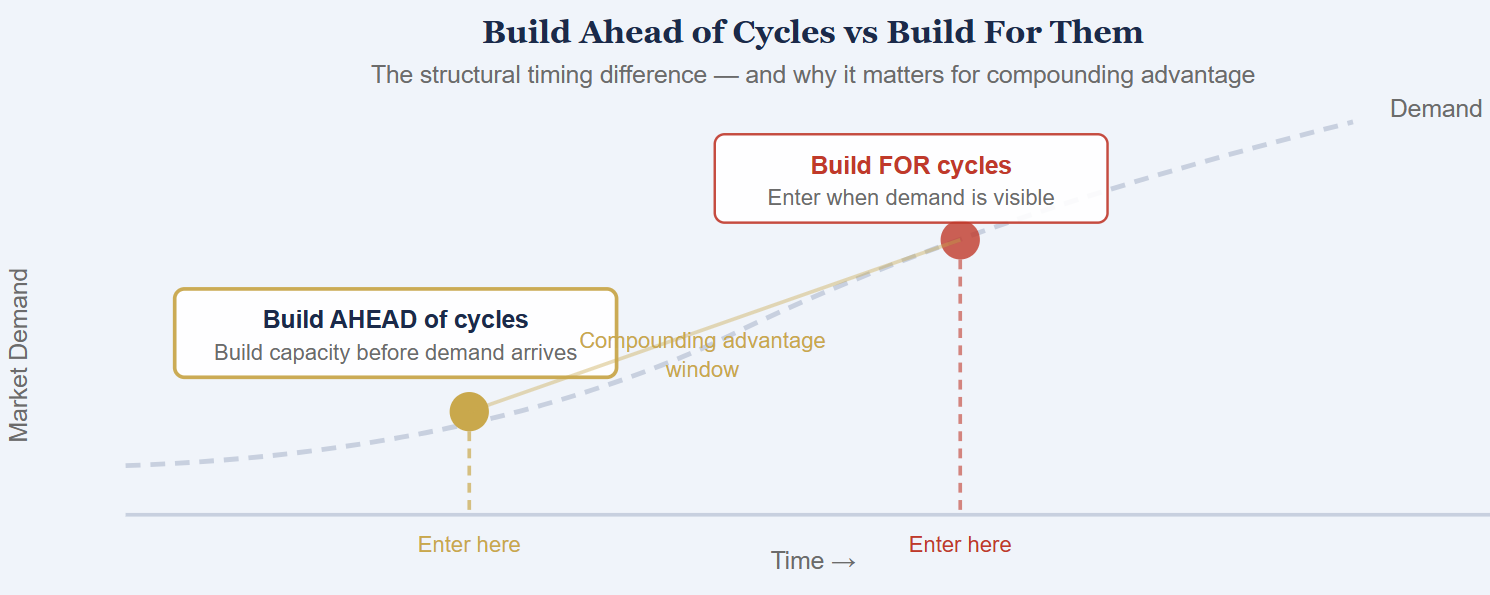
Building for a market means entering when demand is visible, momentum is established, and the opportunity has been validated by other people’s willingness to pay. This sounds prudent. It is actually one of the most competitive and margin-compressing positions available to a founder, because the same visible demand that attracted you attracted ten other well-funded competitors simultaneously.
Building ahead of a market means identifying structural demand that does not yet appear in the transaction data — demand that is logical, derivable from demographic or economic trends, and certain to arrive — and having the conviction and capital discipline to build the capacity before the market officially shows up.
What This Actually Requires
It requires three things that are genuinely difficult to maintain simultaneously: analytical precision (to distinguish structural demand from wishful thinking), financial discipline (to build during the period when the market has not yet arrived, without overspending), and patience that outlasts most institutional incentive structures. The third is the hardest. Most investors and business partners are measured on shorter cycles than structural market development requires. Building ahead of cycles means accepting a period of apparent under-performance before the compound advantage materializes.
Gulf News captured this directly in a headline about Karma Developers: “Karma Developers builds ahead of next cycles.” That is not a marketing claim. It is a description of the operational posture the company has maintained since 2013. The sustainable development infrastructure we put in place at Karma — the LEED-aligned standards, the energy-efficient systems, the community wellness frameworks — looked like expensive optionality in 2013. By 2023 and 2024, when ESG requirements became genuine market demand from buyers and institutional investors, those investments were competitive advantages that newer entrants could not replicate quickly.
The Patience Problem
The hardest part of building ahead of cycles is the conversation that happens during the gap — the period between when you have made your commitment and when the market arrives. At Karma Developers, that gap existed most visibly between 2015 and 2019, when Dubai’s real estate market was soft and most developers were pausing or pivoting. We kept building. We were not being stubborn. We were executing the thesis: the structural demand — a large, growing professional population with limited access to well-designed housing — had not changed. Only the transaction volume had temporarily contracted.
The compound consequence of that patience materialized dramatically from 2021 onward. By that point, Karma had established a market position, a delivery track record, and a brand trust that developers who paused between 2015 and 2019 had to rebuild from scratch. You cannot compress the time it takes to earn a delivery track record. It is, by definition, accrued over time.
The Framework
Why These Three Founding Principles Reinforce Each Other
These three founding principles are not independent. They form a system. Principle one (intersect infrastructure, capital and technology) determines where to look for durable opportunity. Principle two (purpose before product) determines why to build — what structural need justifies the commitment. Founding principle three (build ahead of cycles) determines when to enter and how to position.
Remove any one of them and the other two become weaker. Build at the right intersection without a clear purpose and you will make technically correct but strategically empty investments — the right market with no clear user whose life you are measurably improving. Build with purpose but follow cycles rather than precede them and you will find yourself competing against well-funded peers for the same customers at the same time with no positional advantage. Build ahead of cycles without the infrastructure-capital-technology filter and you will identify markets before they are ready but have no moat to defend when they arrive.
Together, the three form a selection and timing system that has produced — across four companies, three industries, and more than two decades — a consistent pattern: businesses that took time to establish, appeared contrarian in their early years, and compounded into durable platforms once the structural demand they anticipated arrived.
For a deeper look at how these founding principles are currently being applied in the PropTech investment context through Sophonos Investments, read PropTech Venture Capital 2026: Where the Smart Money Is Going. For the real estate application at Karma Developers, Dubai Real Estate Market H2 2026: What Investors Need to Know Right Now lays out how cycle-ahead positioning is operating in practice in the current market.
Serial Entrepreneur Founding Principles — Questions Answered
What are the founding principles of a serial entrepreneur?
The three founding principles that have shaped every company he has built are: (1) Build where infrastructure, capital, and technology intersect — finding problems at the junction of physical systems, financial frameworks, and emerging technology; (2) Let purpose precede product — beginning with a durable thesis about what needs to change, not a specific product idea; and (3) Build ahead of cycles, not for them — identifying structural demand before it becomes visible in transaction data, and building capacity before competitors arrive.
What is the difference between building for cycles and building ahead of cycles?
Building for cycles means entering a market when demand is already visible — when growth is confirmed and the opportunity has been validated by other participants. This is competitive and margin-compressing, as many well-funded players enter simultaneously. Building ahead of cycles means identifying structural demand that is logically derivable from demographic or economic trends before it appears in transaction data, and building capacity and market position before the demand officially arrives. The compounding advantage of the ahead-of-cycle approach is positional: by the time the market peaks, you have a delivery track record and brand trust that new entrants cannot compress or replicate.
How many companies has Navneet Mandhani founded?
Navneet Mandhani has founded four companies: Voyzze Communications (2010, exited 2013) — a VoIP company in North America; Karma Developers (2013) — an international real estate platform with 2,000+ homes delivered across the UAE, UK, Cyprus, Romania, and Australia; Future Resources FZE (2013) — a global commodities trading enterprise; and Sophonos Investments (2018) — a private investment platform with $500M+ in AUM across 26+ portfolio companies in PropTech, AI, FinTech, and DeepTech.
What is Navneet Mandhani’s business philosophy?
Navneet Mandhani’s business philosophy, as described in his Forbes Business Council profile, centres on “identifying opportunities where infrastructure, capital and technology intersect to create long-term value.” His approach is characterised by purpose-first building — beginning with a structural thesis about what an industry needs rather than a specific product — and a contrarian, long-horizon perspective that prioritises building ahead of market cycles rather than following them. Entrepreneur Middle East has described his approach as “a steadfast commitment to purposeful value creation” with “a contrarian approach enabling the organisation to anticipate market shifts.