
Most investors in Dubai property are looking at the wrong part of the price spectrum. The compelling risk-adjusted opportunity in 2026 is not in prime luxury — where yields have compressed below 5% — and it is not in budget segments that are running out of room. It is in the middle: the affordable luxury micro-markets where design quality meets investable yields and capital growth has only just begun.
I co-founded Karma Developers in 2013 on a thesis that most of the Dubai property market considered counterintuitive: that the most durable opportunity was not in selling to the wealthiest buyers, but in building quality homes — genuinely well-designed, well-specified, sustainability-conscious homes — for the professional class that was growing fastest and being served worst by the market at the time. We called it affordable luxury before anyone else in Dubai was using that phrase.
Thirteen years later, I want to update that thesis for 2026. The underlying logic has not changed. What has changed is the precise location of the opportunity within the price spectrum — and the emergence of specific micro-markets that, right now, represent the most compelling combination of capital growth, rental yield, quality infrastructure, and entry price that this city has seen in a decade.
This post is data-driven. Every figure I cite is from a named source. I will tell you where the numbers come from.
Defining the Segment
What “Affordable Luxury” Actually Means in Dubai’s Property Market in 2026
Dubai is not one property market. As Takween AlDar’s May 2026 market guide correctly notes: “Ask two people what property costs per square foot in Dubai, and you’ll get two very different answers. One might quote you AED 1,400. Another will say AED 4,000. Both are correct because Dubai is not one market. It’s a collection of distinct micro-markets, each with its own price dynamics, buyer profile, supply conditions, and growth trajectory.”
Within that collection, affordable luxury in 2026 occupies a specific band: approximately AED 1,200 to AED 1,800 per square foot. This is:
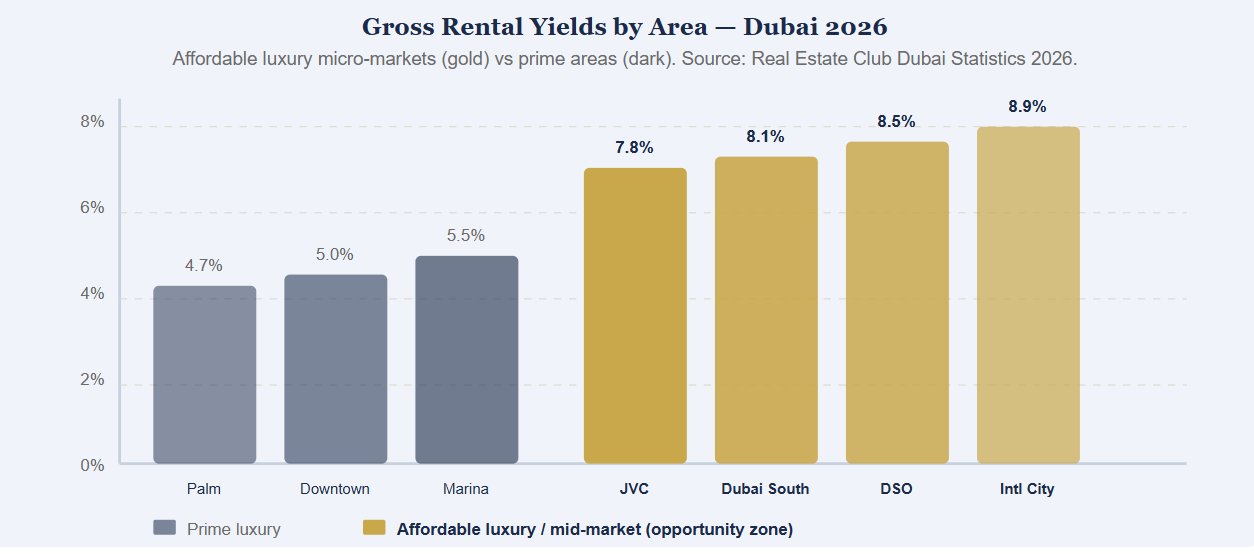
Below the prime luxury threshold — Downtown Dubai (AED 3,000/sqft), Dubai Marina (AED 2,600/sqft), and Palm Jumeirah (AED 3,750/sqft) sit well above this range. These are areas where capital appreciation has already compounded significantly and where gross rental yields have compressed to 4–5%.
Above the budget segment — International City (AED 775/sqft), Deira/Bur Dubai (AED 900/sqft), and Discovery Gardens deliver the highest gross yields (8.9–9%+) but limited capital appreciation potential, aging stock, and a tenant profile that creates higher management complexity.
The sweet spot where you get modern design standards, community-grade amenities (pools, gyms, landscaped grounds, access to schools and retail), professional tenant demand, gross yields of 7–9%, and a capital growth trajectory that has consistently outperformed both ends of the spectrum in 2024 and 2025.
The Price Spectrum at a Glance — Q1 2026 DLD Data
- Palm Jumeirah: AED 3,750/sqft | Yield 4.7%
- Downtown Dubai: AED 3,000/sqft | Yield ~5%
- Dubai Marina: AED 2,600/sqft | Yield ~5.5%
- Dubai Hills Estate: AED 2,350/sqft | Yield 5.8%
- Business Bay: AED 2,200/sqft | Yield 6.2%
- JVC: AED 1,460/sqft | Yield 7.8%
- Dubai South: AED 1,550/sqft | Yield 8.1%
- International City: AED 775/sqft | Yield 8.9%
Sources: TruHauz Dubai Real Estate Market Data 2026; Real Estate Club Dubai Statistics 2026; DLD Q1 2026 transaction records
The Core Thesis
Why Micro-Markets Are Where the Real Compounding Is Happening
The conventional wisdom in Dubai property investing — particularly among international buyers — is to anchor on the headline addresses. Palm Jumeirah. Downtown. Marina. These areas are legitimate. They are liquid, globally recognised, and well-managed. But they are also the areas where the investment case has already been made by hundreds of thousands of buyers before you. The asymmetry of information that once existed in these markets has long since been arbitraged away.
Micro-markets work differently. A micro-market is a community-level area — not a district, not a zone, but a specific planned community — that has its own supply dynamics, its own tenant base, its own infrastructure trajectory, and its own pricing logic. Dubai’s property market contains dozens of them. Most international investors do not track them. That is precisely why they still offer compelling risk-adjusted returns.
“Dubai is a collection of distinct micro-markets, each with its own price dynamics, buyer profile, supply conditions, and growth trajectory. The city-wide average tells you almost nothing about what your specific unit will do.”
— Takween AlDar, Dubai Property Price Per Sqft Guide 2026
The Migration Pattern That Is Repricing Everything
The most important thing happening in Dubai’s affordable luxury segment in 2026 is a migration pattern that is systematically repricing the micro-market tier upward. Here is how it works:
- Step 1: A community that was once “affordable” — JVC is the clearest case — crosses a price threshold that makes it inaccessible to true budget buyers. JVC studio rents have jumped from AED 35,000 to AED 48,000+, and apartment prices have crossed AED 900–1,460/sqft. JVC is no longer affordable. It is now mid-market, per the Real Estate Club Dubai’s June 2026 analysis.
- Step 2: Budget and first-time buyers migrate to the next tier — Arjan, Dubai South, Town Square, Dubai Silicon Oasis — bringing their demand with them. This demand, applied to communities with constrained near-term supply and improving infrastructure, drives prices upward.
- Step 3: The communities that absorbed the migration begin their own appreciation cycle — and early investors in those communities realise the returns that JVC investors realised five years earlier.
This cycle has repeated multiple times in Dubai’s micro-market history. Understanding where each community sits in the cycle at a given moment is the core skill of micro-market investing.
Where the Opportunity Is
Five Affordable Luxury Micro-Markets Worth Watching in 2026
| Area | Price/sqft | Gross Yield | 2025 Growth | Stage |
| JVC | AED 1,460 | 7.80% | Plus 11% | Established |
| Dubai South | AED 1,550 | 8.10% | Plus 22.8% | Accelerating |
| Arjan | ~AED 1,400 | 8%+ | Plus 14% | Emerging |
| Dubai Silicon Oasis | AED 1,300–1,500 | 8.50% | Plus 18.2% | Accelerating |
| DAMAC Hills 2 | AED 1,200–1,400 | 7.50% | Plus 19.1% | Growing |
| Comparison: | ||||
| Palm Jumeirah | AED 3,750 | Yield 4.7% | Plus 18.5% | Prime |
Jumeirah Village Circle (JVC) — The Established Workhorse
JVC has graduated from “affordable” to “mid-market affordable luxury” — and that graduation is exactly why it still deserves attention. At AED 1,460/sqft with a gross yield of 7.8%, it remains the city’s most liquid mid-tier community. It is centrally located with quick highway access, and popular precisely because it is affordable and rental demand stays consistently strong, with gross yields hitting 7–9%, among the strongest of any established Dubai community. The critical investment consideration at JVC in 2026 is selectivity within the community: newer buildings with premium finishes and genuine amenity packages outperform older stock by 15–20% on both yield and resale value.
Dubai South — The High-Growth Emerging Play
Dubai South delivered +22.8% price growth in 2025 — the highest of any Dubai community tracked by Bayut/Dubizzle — against a current average of AED 1,550/sqft and gross yields of 8.1%. The structural driver is clear: proximity to Expo City Dubai (now a permanent urban development hub), Al Maktoum International Airport expansion (which will eventually be the world’s largest airport), and the NEOM corridor of logistics and trade infrastructure. At current entry prices, Dubai South represents the clearest expression of the “build ahead of cycles” thesis in Dubai’s residential micro-market landscape. Dubai South saw one of the highest price gains, with new inventory drawing first-time buyers at 9–25%.
Arjan — Constrained Supply, Quality Demand
Arjan’s investment case rests on a supply dynamic that is distinctive within Dubai’s mid-market: Arjan ranked in the top five neighbourhoods in Dubai for property transactions, with rents approximately 10% higher than in neighbouring JVC and 80% fewer vacant units. This combination — lower vacancy, stronger rents, and proximity to Dubai Miracle Garden and an improving retail and F&B ecosystem — makes Arjan one of the most supply-constrained affordable luxury communities in the city. Entry prices around AED 1,350–1,500/sqft represent a narrow window before the JVC migration pattern fully reprices this community upward.
Dubai Silicon Oasis — Infrastructure Catalyst
Dubai Silicon Oasis delivered +18.2% price growth in 2025 — the fifth-highest in Dubai — partially catalysed by Blue Line Metro announcements. Dubai Silicon Oasis posted a significant jump in prices following the Blue Line Metro news. At AED 1,300–1,500/sqft and gross yields of 8.5%, DSO serves a specialised but deep tenant base: technology workers, engineers, and professionals employed in the Dubai Silicon Oasis Authority’s free zone ecosystem. This tenant base has lower turnover rates and higher lease renewal probability than purely investor-driven communities.
DAMAC Hills 2 — Villa-Format Affordable Luxury
For buyers seeking affordable luxury in the villa and townhouse format — the category that has been structurally undersupplied across all of Dubai in 2026 — DAMAC Hills 2 represents the most accessible entry point. At AED 1,200–1,400/sqft with 7.5% gross yields and +19.1% price growth in 2025, the community offers genuine land-attached living at a price point approximately 4–5x below what the same configuration costs in Palm Jumeirah or Emirates Hills.
The Founding Thesis
Why Karma Developers Was Built Specifically for This Segment
When Capt. Dr. Pradeep Singh and I founded Karma Developers in 2013, the Dubai market offered developers two comfortable positions: ultra-luxury, where margins were high and the buyer was international; or pure budget, where volume was the strategy. The space in between — quality housing at professional-class price points — was occupied by almost nobody building with genuine design discipline, sustainability standards, and long-term community thinking.
We entered that space deliberately. The affordable luxury thesis was not a compromise between two better options. It was a conviction that the structural demand — a rapidly growing professional population in Dubai with rising incomes, quality expectations, and limited access to well-designed homes at non-luxury prices — was the most durable demand category in the city.
Thirteen years later, that conviction has been validated not just by Karma’s delivery track record — 2,000+ homes across five countries — but by the market data above. The affordable luxury segment in Dubai has consistently outperformed the prime segment on total return (yield + appreciation) across every year since 2020 except the anomalous 2022 peak. The market has caught up with the thesis. But the thesis is still running ahead of it.
The Affordable Luxury Investment Case — Summary
- Yield advantage: 7.8–8.9% gross (mid-market) vs 4.7–5.5% (prime) — a structural yield premium of 250–400 basis points
- Capital growth: Dubai South (+22.8%), DSO (+18.2%), DAMAC Hills 2 (+19.1%) — consistently above prime market averages in 2025
- Entry point: AED 1,200–1,800/sqft vs AED 2,600–3,750/sqft in prime — 50–65% lower capital requirement
- Golden Visa: Two affordable luxury units combined can reach AED 2M threshold
- Migration tailwind: JVC’s repricing is already pushing buyer demand into Arjan, Dubai South, and DSO
Why Now
Why the 2026 Entry Window in Affordable Luxury Is Closing
The affordable luxury thesis is not new. What is specific to 2026 is the combination of factors that make this year a particularly compelling entry point — and the factors that suggest the window for AED 1,200–1,600/sqft pricing in quality communities will narrow significantly over the next 18–24 months.
Factor 1: JVC’s repricing creates a demand migration wave. As established in Section 2, JVC’s graduation to mid-market is already pushing first-time and yield-focused buyers into the next tier of communities. This demand migration has been confirmed by the June 2026 Real Estate Club Dubai analysis. Budget buyers are migrating to Dubai South, Town Square, Arjan, Dubailand, and MBR City Phase 2 for units under AED 500K–800K. The communities absorbing this migration are at the early stages of their repricing cycle.
Factor 2: Metro expansion is a structural price catalyst. The Dubai Metro Blue Line — confirmed and under construction — will connect several affordable luxury communities to the broader transit network. Dubai Silicon Oasis posted the highest price jump following Blue Line Metro news, with prices up 29% per square foot. Communities that currently require car dependency but are in the metro’s planned catchment area are pricing in future transit access. The window for pre-transit prices in these areas is limited.
Factor 3: Supply is tighter than it appears. The 120,000-unit handover pipeline for 2026 — the largest in Dubai’s history — sounds alarming to investors who read the headline. But as I covered in the H2 2026 market analysis, the historical completion rate is approximately 56%, bringing actual handovers to around 60,000–70,000 units. And within that, villa supply is only 15,284 units — severely constrained relative to demand, which explains why villa prices have held firm at +16.2% year-on-year.
Factor 4: The Golden Visa combining strategy. At AED 1,200–1,600/sqft, two well-chosen affordable luxury units can be combined to reach the AED 2 million Golden Visa threshold. For NRI and international buyers — a group that accounts for approximately 20% of Dubai’s foreign property transactions — this makes the affordable luxury tier a vehicle for achieving UAE residency at a capital cost significantly below what a single prime unit would require. For a full guide on this, see the NRI Guide to Investing in Dubai Property 2026.
What the Data Suggests About the Window
JVC crossed from “affordable” to “mid-market” at approximately AED 900–1,000/sqft — a threshold it reached between 2022 and 2023. The same trajectory, applied to Arjan (currently ~AED 1,350–1,400/sqft) and Dubai South (AED 1,550/sqft), suggests these communities will hit the mid-market threshold within 2–4 years if demand migration from JVC continues at the current pace. Investors who wait for the repricing to be fully confirmed by the data will be entering at the point where the easy compounding has already happened.
Affordable Luxury Real Estate Dubai 2026 — Questions Answered
Data-verified answers to the most searched questions about affordable luxury property investment in Dubai.
What is affordable luxury real estate in Dubai?
Affordable luxury real estate in Dubai in 2026 refers to the mid-market segment priced between AED 1,200 and AED 1,800 per square foot — below the prime luxury threshold of AED 2,500+ per sqft and above the budget segment below AED 900/sqft. Key communities include JVC (AED 1,460/sqft), Dubai South (AED 1,550/sqft), Arjan (~AED 1,400/sqft), Dubai Silicon Oasis (AED 1,300–1,500/sqft), and DAMAC Hills 2 (AED 1,200–1,400/sqft). These areas offer modern finishes, quality amenities, and gross yields of 7.5–8.9%.
Which Dubai micro-markets offer the best affordable luxury in 2026?
Based on Q1 2026 DLD data, the strongest affordable luxury micro-markets are: Dubai South (8.1% yield, +22.8% growth); Dubai Silicon Oasis (8.5% yield, +18.2% growth); Arjan (~8% yield, 80% fewer vacant units than JVC, rents 10% higher); JVC (7.8% yield, highest liquidity in its tier); and DAMAC Hills 2 (7.5% yield, +19.1% growth, villa format). Each community is at a different stage of the repricing cycle that JVC completed earlier — making the entry timing analysis central to the investment case.
What are rental yields like in Dubai’s affordable luxury areas in 2026?
Gross rental yields in Dubai’s affordable luxury communities range from 7.5% to 8.9% in 2026 — compared to 4.7% in Palm Jumeirah and ~5% in Downtown Dubai. International City leads at 8.9%, Dubai Silicon Oasis at 8.5%, Dubai South at 8.1%, JVC at 7.8%, and DAMAC Hills at 7.5%. Dubai’s zero property tax environment makes these gross yields translate to significantly higher net returns than equivalent yields in London (2–4%) or New York (2–3%).
What is the price per sqft in Dubai’s affordable luxury areas in 2026?
Based on Q1 2026 DLD-registered transaction data: JVC averages AED 1,460/sqft; Dubai South AED 1,550/sqft; Arjan approximately AED 1,350–1,500/sqft; Dubai Silicon Oasis AED 1,300–1,500/sqft; DAMAC Hills 2 AED 1,200–1,400/sqft. The city-wide apartment average was AED 1,600/sqft in Q1 2026. Prime areas — Palm Jumeirah (AED 3,750), Downtown (AED 3,000), Marina (AED 2,600) — are priced 2–6x above the affordable luxury threshold.
Why is 2026 a good time to invest in Dubai affordable luxury property?
Four factors make 2026 a compelling entry point: (1) JVC’s repricing to AED 1,460/sqft is driving buyer demand into next-tier communities like Arjan, Dubai South, and DSO — creating a demand migration wave that reprices these areas upward; (2) Dubai Metro Blue Line construction is creating pre-transit price windows in communities that will gain connectivity; (3) Gross yields of 7.8–8.9% represent a 250–400 basis point premium over prime areas; (4) Two affordable luxury units combined can reach the AED 2M Golden Visa threshold. The window for pre-migration, pre-transit pricing in quality communities is narrowing.