
Indians have been Dubai’s largest foreign buyer group for 10 consecutive years. But the rules, the costs, and the strategic opportunities in 2026 are more nuanced than most guides acknowledge. This is the complete, verified picture — from RBI’s LRS framework to DLD fees to Golden Visa eligibility.
I have built Karma Developers from the ground up in Dubai since 2013 — 2,000+ homes delivered, five countries, a multi-billion-dirham development pipeline. In that time I have watched Indian buyers go from an active minority in Dubai’s property market to its single largest foreign buyer group, accounting for approximately 20% of all foreign transactions. And I have watched the questions those buyers ask evolve from “Can we buy here?” to something considerably sharper: “What does it actually cost, what are the rules, and what are the real opportunities in 2026?” This guide answers those questions precisely. Every figure in it has been verified from official sources — the Reserve Bank of India, the Dubai Land Department, and authoritative 2026 market data. Where I express a view, I have identified it as such. This is not a promotional document. It is the guide I wish had existed when I first started advising Indian partners and co-investors on the Dubai property market.
Can NRIs and Indians Buy Dubai Property in 2026? The Short Answer
Yes — and the process is simpler than most people expect. Dubai has permitted freehold property ownership by foreign nationals in designated freehold zones since 2002. There is no requirement for UAE residency, no local sponsor, and no minimum investment amount for the purchase itself. An Indian citizen — whether living in India or abroad — can complete a Dubai property transaction entirely in their own name. However, the rules differ significantly depending on which category of Indian buyer you are. The distinction matters for how you move money, how much you can move, and what compliance obligations follow.
The Two Categories — NRI vs Resident Indian
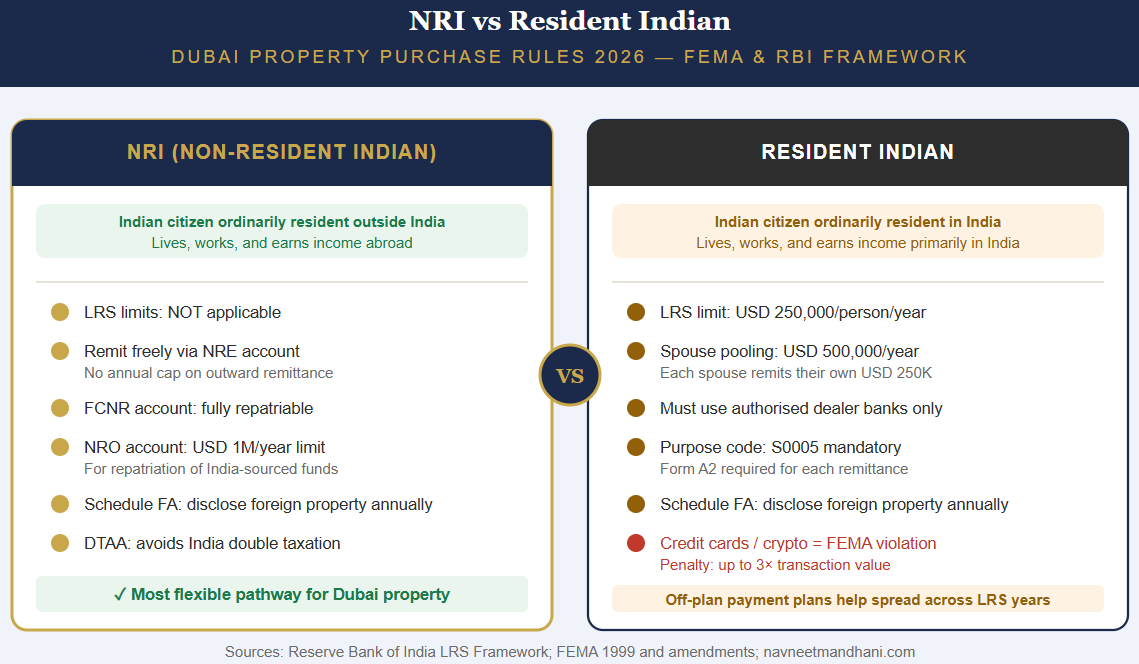
Non-Resident Indian (NRI): An Indian citizen who is ordinarily resident outside India — lives and works in another country, spends most of the year abroad, files taxes as a non-resident in India. NRIs are NOT subject to the RBI’s Liberalized Remittance Scheme limits. They can use foreign-earned income directly, or remit freely from their NRE (Non-Resident External) or FCNR (Foreign Currency Non-Resident) accounts. There is no annual cap.
Resident Indian: An Indian citizen who lives and works in India, spends most of the year in India. Must use the RBI’s Liberalized Remittance Scheme (LRS) — limited to USD 250,000 per person per financial year (April to March). A married couple can pool their individual allowances for USD 500,000 per year. Off-plan payment plans spread across multiple years can accommodate larger purchases within LRS limits.
How Resident Indians Can Legally Fund a Dubai Property Purchase
For Resident Indians (not NRIs), the Liberalized Remittance Scheme is the primary legal pathway for sending money abroad to purchase property. Understanding its mechanics — and its limits — is essential before any transaction.
What LRS Allows
Under LRS, each Resident Indian can remit up to USD 250,000 per financial year (April 1 to March 31) for overseas property investment. This includes the purchase price, DLD fees, and other acquisition costs. Your bank will require:
- Form A2: Completed at your authorized dealer bank — the mandatory declaration for LRS remittances above USD 10,000.
- Purpose Code S0005: The specific RBI purpose code for “Acquisition of immovable property outside India.” Using the wrong code creates compliance mismatches that can surface during tax audits.
- Sale and Purchase Agreement: Banks typically require the SPA or booking form before processing a property-related remittance under LRS.
- Schedule FA Disclosure: You must report the foreign asset in Schedule FA (Foreign Assets) of your Indian income tax return every year you hold the property — regardless of whether any tax is owed.
Strategies for Purchases Above USD 250,000
Many Dubai properties cost above USD 250,000 (~AED 920,000). Compliant strategies include:
- Spouse pooling: A married couple can each remit USD 250,000 in the same financial year for a combined USD 500,000 (~AED 1.84 million). Property can be registered in joint names.
- Multi-year accumulation: Off-plan payment plans — commonly 60/40 or 80/20 structures with milestones spread over construction — allow purchases up to USD 750,000 to be funded across three financial years within the LRS limit, while staying fully compliant.
Critical FEMA Compliance Warning Indian enforcement authorities have increased scrutiny of Dubai property transactions. Do not use the following channels — each constitutes a FEMA violation: credit cards, cryptocurrency wallets, free-trade zone shell companies, or any payment routed outside an RBI-authorized dealer bank. FEMA violations attract penalties of up to three times the transaction value. The Black Money (Undisclosed Foreign Income and Assets) Act allows tax and penalties of up to 120% of the asset value for undisclosed foreign property.
NRI Advantage: No LRS Limits
If you qualify as an NRI under FEMA — ordinarily resident outside India with foreign income — the LRS restrictions above do not apply to you. You can remit from your NRE account with no annual cap, or from your NRO account subject to a USD 1 million annual repatriation limit. Many Indian families accelerate their move to the UAE specifically to acquire NRI status before completing a Dubai property purchase.
How a Dubai Property Transaction Works for Indian Buyers
Property Selection and Due Diligen0ce
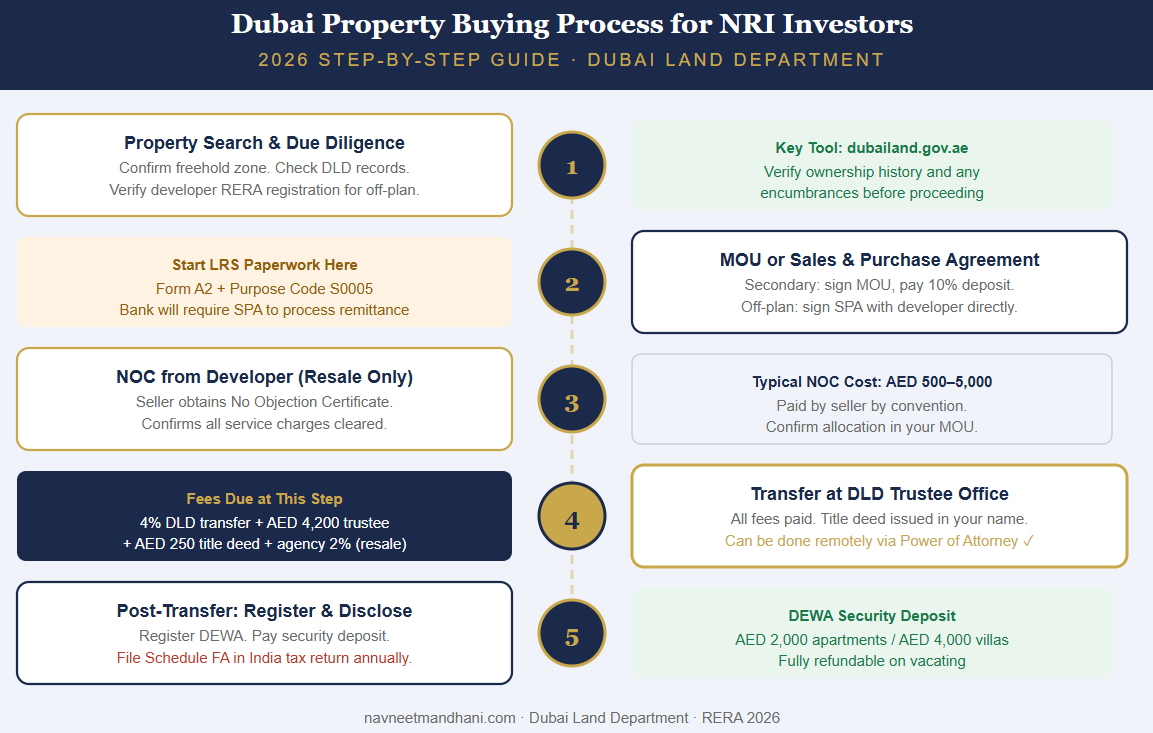
Verify the property is in a designated freehold zone. Check DLD records at dubailand.gov.ae. Confirm the developer’s RERA registration for off-plan. Check service charges on the DLD’s service charge index.
Memorandum of Understanding (MOU) or Sales and Purchase Agreement (SPA)
For secondary market: MOU is signed, 10% deposit typically paid. For off-plan: SPA signed directly with developer, booking deposit of 5–20% depending on project.
NOC from Developer (Secondary Market)
If buying a resale property, the current owner obtains a No Objection Certificate from the developer confirming all service charges are paid. Cost: typically AED 500–5,000, paid by seller by convention.
Transfer at Trustee Office
Both buyer and seller (or their Power of Attorney holders) attend an authorized DLD trustee office. All fees paid. Title deed issued in buyer’s name. Can be done remotely via Power of Attorney — critical for NRIs based outside UAE.
Post-Transfer: DEWA, Service Charges, Schedule FA
Register with DEWA (Dubai Electricity and Water Authority), pay the refundable security deposit (AED 2,000 apartments / AED 4,000 villas). Register for service charges with the building. Report the asset in Schedule FA of your Indian tax return.
Remote Purchase Is Fully Possible Indian buyers routinely complete Dubai property transactions without visiting the UAE. A notarized and attested Power of Attorney allows a representative in Dubai to sign all documents and attend the trustee office on your behalf. Off-plan purchases from developers are even simpler — many are completed entirely online.
What Does It Actually Cost to Buy Dubai Property in 2026?
This is the section most guides get wrong. The purchase price is only the starting point. Total acquisition costs in Dubai in 2026 typically run 7–10% above the listed price — closer to 7–8% for a cash purchase, 8–10% with a mortgage. Every figure below is from confirmed Dubai Land Department fee schedules and market data.
| Fee | Amount | Who Pays | Notes |
| DLD Transfer Fee | 4% of purchase price | Buyer (by convention) | The largest government cost. Fixed. Paid at trustee office. |
| DLD Admin Fee | AED 580 (ready) / AED 40 (off-plan) | Buyer | Fixed administrative charge on top of the 4%. |
| Trustee Office Fee | AED 4,200 (above AED 500K) / AED 2,000 (below) | Buyer | Paid at the authorized trustee office where transfer occurs. |
| Title Deed Issuance | AED 250 | Buyer | Fixed fee for issuing the title deed in your name. |
| Agency Commission | 2% of sale price + 5% VAT | Buyer | Secondary (resale) market only. Usually nil for off-plan — developer pays the agent. |
| DEWA Security Deposit | AED 2,000 (apt) / AED 4,000 (villa) | Buyer | Fully refundable on vacating. |
| Mortgage Registration Fee | 0.25% of loan value + AED 290 | Buyer | Only applicable if using mortgage financing. |
| Bank Processing / Arrangement Fee | Up to ~1% of loan | Buyer | Varies by lender — often negotiable for strong profiles. |
| Property Valuation Fee | AED 2,500–3,500 | Buyer | Required by banks for mortgage approval. |
| NOC Fee | AED 500–5,000 | Seller (by convention) | Developer issues NOC to seller; confirm allocation in MOU. |
| Total Typical Range | 7–8% (cash) / 8–10% (mortgage) | Budget ~AED 140,000–200,000 on an AED 2M property (cash) |
Off-Plan Cost Advantages — 2026 When buying off-plan directly from a developer in 2026, you typically pay zero agency commission (developer pays the agent). Additionally, in a mid-cycle market, many developers are offering to cover 50–100% of the 4% DLD transfer fee as a sales incentive. This can reduce your acquisition cost to as little as 0.5–1% above the purchase price for an off-plan unit. Always confirm what the developer is covering in writing before signing the SPA.
The Dubai Property Golden Visa in 2026: What NRIs Need to Know
For many Indian buyers, the Golden Visa is as significant as the investment itself — and the rules in 2026 are more accessible than in previous years.
The Core Rule
A Dubai property investment of AED 2 million or more qualifies for the UAE’s 10-year renewable Golden Visa. This is the threshold set in March 2022 and confirmed unchanged in 2026. The visa:
- Requires no UAE national sponsor
- Includes family sponsorship (spouse, children, in some cases parents)
- Does not require the holder to live in the UAE to maintain it
- Is renewable as long as the qualifying property is owned
2026 Updates to Golden Visa Rules
- Off-plan properties now qualify. As of 2026, off-plan properties from approved developers can qualify for the Golden Visa, provided the total purchase price meets AED 2 million — even with a payment plan. You do not need to pay the full amount upfront.
- Multiple properties can be combined. You can aggregate multiple Dubai properties to reach AED 2 million — five studios worth AED 400,000 each qualifies just as one apartment worth AED 2 million does, provided the combined DLD-recorded valuation reaches the threshold.
- April 2026 — 2-year investor visa threshold removed. Dubai removed the AED 750,000 minimum requirement for the 2-year property investor visa in April 2026, widening access to UAE residency for investors below the Golden Visa threshold. The 10-year Golden Visa AED 2 million threshold remains.
The NRI Tax Advantage at AED 2M Golden Visa Level A 2-bedroom apartment in Dubai Marina generating AED 150,000 per year in rental income equals approximately INR 34 lakh per year. In Dubai: zero tax. The same income earned in India would be subject to income tax at applicable slab rates. The combination of the Golden Visa and zero UAE property taxation makes the AED 2M threshold a significant inflection point for NRI investors.
Tax Treatment for NRIs: UAE and India
Dubai’s tax profile for property investors is exceptional by global standards — and the India-UAE tax treaty provides a framework that prevents NRIs from being caught twice.
UAE Side: No Tax on Property
Dubai imposes zero property tax, zero capital gains tax, and zero income tax on rental income at the emirate level. This is not a temporary relief or an exemption — there is simply no such tax in the UAE’s framework. Whether you rent your property or sell it at a profit, the UAE does not take a share.
India Side: DTAA Protection
The Double Taxation Avoidance Agreement (DTAA) between India and the UAE — originally signed in 1992 and updated through subsequent protocols — prevents the same income from being taxed by both countries. Under the DTAA, Indian investors in Dubai property generally do not face Indian income tax on UAE rental income, provided they maintain clear NRI status and report correctly. Regardless of tax liability, all NRIs must disclose foreign assets in Schedule FA of their Indian income tax return annually. Failure to disclose — not just failure to pay — is a compliance violation under the Black Money Act.
Long-Term Capital Gains If You Sell If you sell a Dubai property at a profit, Dubai imposes zero capital gains tax. On the India side, under the DTAA, capital gains on foreign property are not typically taxed in India for NRIs. However, for Resident Indians, capital gains on overseas property may be subject to Indian tax under current rules. The specific treatment depends on your residency status at the time of sale. Consult a FEMA-qualified Chartered Accountant for your specific situation before completing any sale.
Rental Yields and Best Areas for NRI Investors in 2026
Dubai’s rental yield profile varies considerably by area and asset type. Unlike markets such as Mumbai and Delhi where gross residential yields typically run 2–3%, Dubai consistently delivers yields that make the numbers work as rental investments as well as capital appreciation plays.

Area Guide for NRI Investors in 2026
| Area | Best For | Gross Yield | Golden Visa |
| Downtown Dubai / Business Bay | Capital appreciation, prestige, lifestyle | 5–7% | Most properties qualify at AED 2M+ |
| Dubai Marina / JBR | Short-term rental, liquidity, secondary market depth | 6–7% | Many 2-bed units qualify |
| Palm Jumeirah | Ultra-luxury, brand value, high rental rates | 4–5.5% | Virtually all properties qualify |
| Dubai Hills Estate | Families, villa market, sustainable community design | 5.5–7% | Most villas qualify |
| Jumeirah Village Circle (JVC) | Yield-maximizing investors, entry-level capital | 7–8.5% | Combination of units required for AED 2M |
| Arjan | High yields, affordable entry, family tenants | 7.5–8.5% | Combination required |
| International City / DIP | Maximum gross yield, high tenant demand | 9–10% | Combination required |
As the founder of Karma Developers, my view is that the strongest risk-adjusted opportunity for NRI investors in 2026 sits in master-planned communities with good lifestyle infrastructure, constrained supply, and developer-backed resale markets — not in isolated high-rise units in oversupplied corridors, regardless of the headline yield. A 10% yield in a building with no secondary market and poor management is worth significantly less than a 7% yield in a community where you can sell within 60 days at a fair price. For my broader analysis of the Dubai real estate market in H2 2026, read this post.
The NRI Pre-Purchase Checklist for Dubai Property 2026

- Confirm your NRI vs Resident Indian status This determines your remittance pathway, LRS applicability, and tax treatment. If unclear, consult a FEMA-qualified Chartered Accountant before starting the search.
- Verify freehold zone eligibility Check that the property is in a designated freehold area on the DLD’s official list. Areas like Deira (old zone) and parts of Bur Dubai are leasehold — foreigners can buy there but on different terms.
- Budget the full acquisition cost — not just the purchase price Add 8–10% for cash purchase, 9–11% for mortgage purchase on top of the listed price. Get this wrong and you will be short of funds at the trustee office.
- Check service charges before signing Use the DLD’s RERA service charge index to verify the per-square-foot annual service charge for the building. A high service charge is a permanent annual cost that reduces your net yield.
- Confirm RERA registration for off-plan developers Off-plan developer must be RERA-registered and the project must be listed on the Dubai REST app. Buyer funds must be deposited into a RERA escrow account — not the developer’s operating account.
- Set up LRS paperwork before remitting Form A2, purpose code S0005, SPA or booking agreement — have these ready before your bank transfers any funds. Retroactive LRS compliance is much harder to establish.
- File Schedule FA every year you hold the property Non-disclosure of foreign assets carries penalties under the Black Money Act regardless of whether any tax is owed. This is a recurring annual obligation from the year of purchase.
- Consider Power of Attorney for remote transactions If you cannot travel to Dubai, a notarized and UAE-attested Power of Attorney allows a trusted representative to complete the transaction at the trustee office on your behalf.
NRI Investing in Dubai Property 2026 — Questions Answered
Can NRIs buy property in Dubai in 2026?
Yes. NRIs can buy freehold property in Dubai’s designated zones in 2026 without UAE residency, a local sponsor, or a minimum investment amount. NRIs use foreign-earned income and are not subject to RBI’s LRS limits — they can remit freely from NRE or FCNR accounts. Indians have been Dubai’s largest foreign buyer nationality for 10 consecutive years, holding approximately 20% of all foreign property transactions.
What are the LRS rules for Indians buying Dubai property in 2026?
Resident Indians (not NRIs) can remit up to USD 250,000 per person per financial year under RBI’s Liberalised Remittance Scheme for overseas property. A married couple can pool for USD 500,000 per year. Funds must go through authorised dealer banks using purpose code S0005 with Form A2. Using credit cards, cryptocurrency, or unofficial channels is a FEMA violation attracting penalties up to 3x the transaction value. NRIs are not subject to LRS limits.
What are the total costs of buying Dubai property in 2026?
Total acquisition costs typically run 7–10% above the purchase price. The main components are the 4% DLD transfer fee, trustee office fee (AED 4,000–4,200 for properties above AED 500,000), agency commission of 2% plus 5% VAT on resale properties (usually nil for off-plan), title deed fee (AED 250), and DLD admin fee (AED 580 for ready property). If using a mortgage, add 0.25% of the loan for mortgage registration plus bank fees. On an AED 2 million cash purchase, expect approximately AED 140,000–160,000 in additional costs.
Does Dubai property qualify for a Golden Visa for NRIs in 2026?
Yes. A property investment of AED 2 million or more in Dubai qualifies for the UAE’s 10-year renewable Golden Visa, with no sponsor required and family sponsorship included. Multiple properties can be combined to reach AED 2 million. As of 2026, off-plan properties from approved developers also qualify. As of April 2026, the AED 750,000 minimum for the 2-year property investor visa was removed, though the AED 2 million Golden Visa threshold remains unchanged.
Do NRIs pay tax on Dubai property income in India?
Dubai imposes zero property tax, capital gains tax, and income tax on rental income. The India-UAE DTAA (Double Taxation Avoidance Agreement, 1992 and updates) prevents the same income from being taxed twice. NRIs with non-resident status in India are generally not taxed in India on foreign income. All NRIs must disclose foreign assets in Schedule FA of their Indian income tax return annually, regardless of tax liability.
Which areas of Dubai are best for NRI property investment in 2026?
For capital appreciation and Golden Visa eligibility: Downtown Dubai, Business Bay, Dubai Marina, Palm Jumeirah, and Dubai Hills Estate. For maximum rental yield: Jumeirah Village Circle (JVC) at 7–8.5%, Arjan at 7.5–8.5%, and International City at 9–10% gross yields. Mid-tier master-planned communities with constrained supply and good lifestyle infrastructure tend to deliver the strongest risk-adjusted returns over a 5-to-10-year holding period.