
$3.30 billion deployed in Q1 2026 alone. A 64% year-on-year surge. But the headline number conceals a more important story, one about concentration, discipline, and which specific categories are commanding institutional-scale capital. Here is what the data actually shows.
I have spent the better part of the last decade allocating PropTech Venture capital across real estate technology through Sophonos Investments, a private investment platform with over $500M in assets under management across 25+ portfolio companies. PropTech is one of the categories I track with the most rigor, and 2026, even in its first quarter, has already produced more insight into where this market is going than most full years I can recall.
What follows is a data-driven analysis grounded in official figures from the Center for Real Estate Technology and Innovation (CRETI), whose Q1 2026 report published in April is the most authoritative quarterly snapshot available. I will also draw on full-year 2025 data from CRETI and Multifamily Dive, MENA-specific intelligence from Wamda and the Dubai Future District Fund, and trend analysis from PwC, JLL Spark, and the National Association of Realtors’ Technology team. I will tell you where the numbers are sourced. I will not guess at figures I have not verified.
The Big Picture
How Did Global PropTech Investment Get Here?
The PropTech market spent 2022 and 2023 in correction mode after the overcapitalized pandemic-era boom. Valuations reset. Seed activity continued quietly. Growth-stage deals dried up. By 2024, the sector had absorbed most of its excess and began signaling recovery. Then 2025 delivered a number that reshaped the conversation entirely.
“$16.7 billion was invested globally in PropTech and adjacent real estate technology companies in 2025, a 67.9% year-on-year increase from 2024, and a figure that surpassed the pre-pandemic 2019 high of approximately $14 billion for the first time.”
Source: Center for Real Estate Technology and Innovation (CRETI), January 2026; Multifamily Dive, January 13, 2026
Within that figure, AI-centered PropTech companies grew investment at 42% annualized in 2025, nearly double the 24% rate for non-AI PropTech companies. Three new PropTech unicorns were minted between July and December 2025, and all three were AI-native, including Bedrock Robotics, which reached a $1.75 billion valuation on the strength of its autonomous construction technology. Over 72% of total PropTech investment in 2025 came from just 31 companies in deals exceeding $100 million, a two-tier market had formed.
2026 arrived with the market in this configuration: aggregate capital recovering strongly, concentrated in a small number of scaled businesses, AI the dominant investment thesis, and discipline at the early stage. Q1 2026 confirmed every one of those trends, and pushed them further.
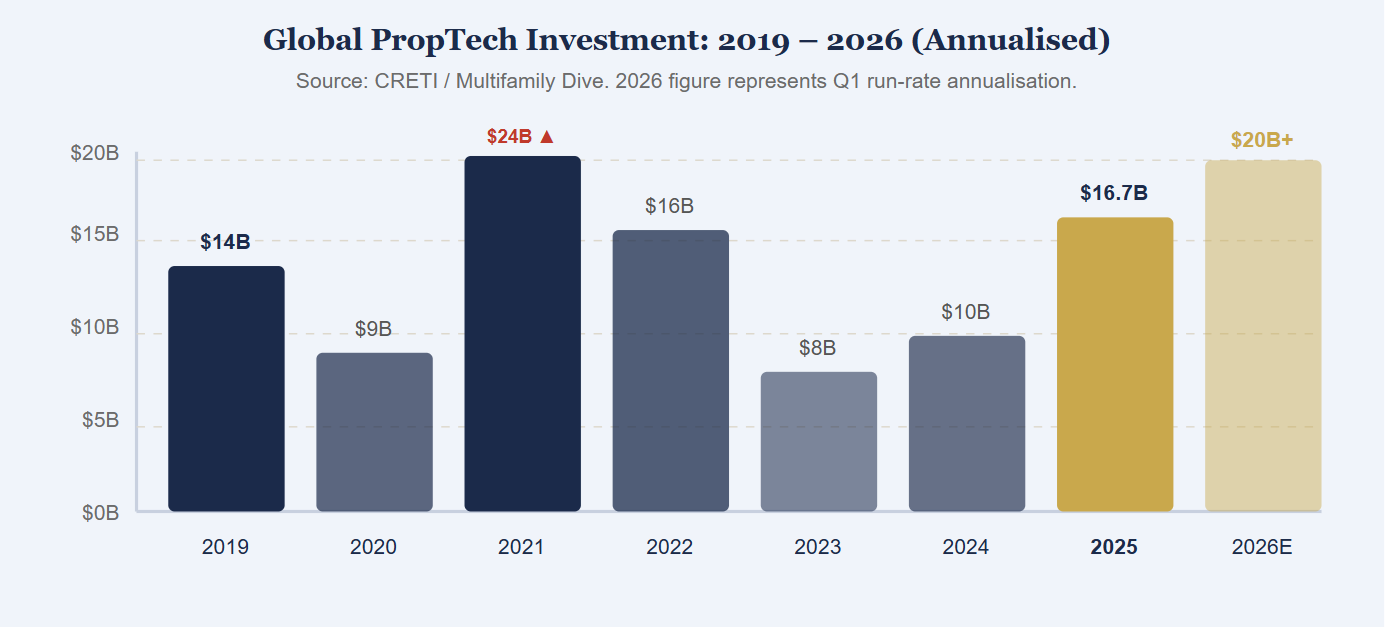
Sources: CRETI; Multifamily Dive.
Q1 2026 Deep Dive
What Q1 2026 Really Tells Us About PropTech Investment Right Now
The CRETI Q1 2026 report, published April 8, is the most granular and authoritative dataset currently available. Its headline, $3.30 billion across 125 transactions compared to $2.01 billion across 114 transactions in Q1 2025 is striking. But the story inside the number is more instructive than the number itself.
The median deal size declined to $8.0 million from $8.4 million even as aggregate capital surged. This apparent contradiction resolves quickly when you look at concentration. The top 10 transactions alone accounted for $2.03 billion, approximately 62% of all capital deployed in the quarter. These are not venture-stage software bets. Several involve debt structures, private equity, and infrastructure-scale financing that reflects where PropTech’s most mature businesses now sit on the capital markets spectrum.
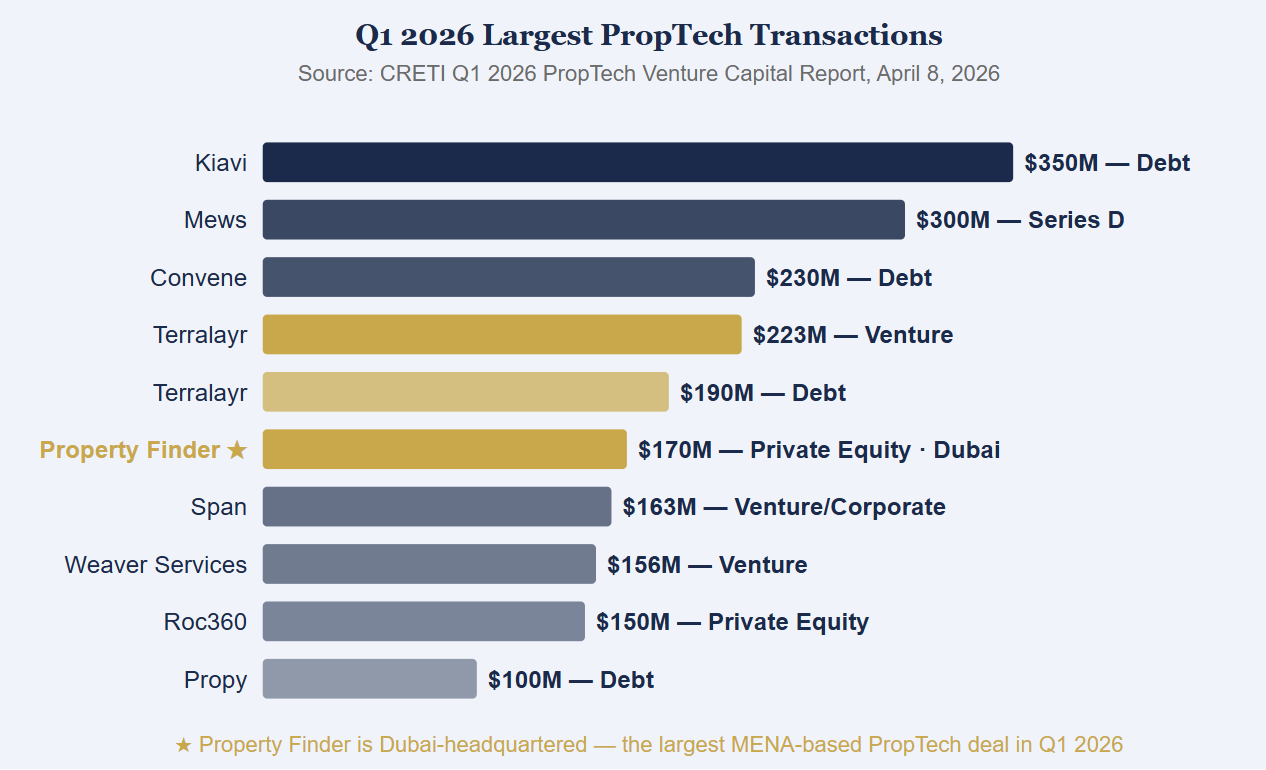
Source: CRETI Q1 2026 PropTech Venture Capital Report.
The early-stage picture tells a different but equally important story. 52 seed and pre-seed transactions were completed in Q1 2026, accounting for roughly 42% of all deal volume, but only approximately 4% of total capital deployed. The largest seed financings included Zero RFI ($13.8M), EstateXchange ($8.4M), Krane ($9.0M), Smart Bricks ($5.0M), and Sitegeist ($4.7M). These companies span construction automation, AI workflow tooling, property infrastructure, and marketplace platforms. Innovation at the early stage is broad. Capital at the early stage is measured. That combination, high deal count, disciplined check size, is what a healthy venture market looks like at the seed tier.
“The increase in capital reflects concentration rather than broad expansion. PropTech is evolving toward a more mature and differentiated capital market structure.”
— Center for Real Estate Technology and Innovation (CRETI), April 2026
Where Capital Is Going
Five Themes Commanding Institutional-Scale PropTech Capital in 2026
AI — Moving From Experiment to Infrastructure
AI’s role in PropTech has fundamentally shifted in 2026. According to PwC and MetaProp’s Global PropTech Confidence Index, AI is no longer just an experimental tool, it is becoming a practical driver of efficiency across operations, construction, and transaction management. The category attracting the most capital is what NAR Technology calls Agentic AI: systems that operate with autonomy, monitor portfolios, predict maintenance needs, manage tenant communication, and optimize energy use without constant human instruction. EliseAI has reached $392M in cumulative funding. PassiveLogic raised a large 2025 Series C, reaching $141M total. These are not pilots. They are infrastructure plays.
Energy and Electrification Systems
Terralayr’s combined $412.9M in Q1 2026 (across two separate financing structures) makes it the single largest capital recipient in the quarter. The company operates in energy infrastructure for the built environment, a direct response to rising global energy bills and increasing ESG requirements. Span’s $163.3M round targets home electrical infrastructure. According to Barchart’s May 2026 analysis, investor focus is converging on PropTech that helps the real estate sector rapidly adapt to sustainable energy sources, driven by both cost pressure and regulatory requirements that are tightening across Europe, the UAE, and the US simultaneously. This is not a niche theme. It is becoming a baseline requirement for new development.
Financial Infrastructure and Lending Platforms
Kiavi ($350M debt), Roc360 ($150M PE), and Propy ($100M debt) represent a category of PropTech that sits at the intersection of real estate and capital markets rather than software. These platforms facilitate property financing, bridge lending, rental property loans, transaction management at scale. The use of debt and private equity structures (rather than traditional venture equity) signals that these businesses have crossed into revenue-generating maturity. Debt accounted for approximately one third of all Q1 2026 PropTech capital, a figure that would have been inconceivable in 2021’s equity-saturated market. The capital stack is diversifying, and that is a mark of sector maturity.
Transaction Platforms and Marketplaces at Scale
Property Finder’s $170M private equity round in Q1 2026 is the deal I watch most closely from a regional perspective. The Dubai-headquartered platform has delivered more than 40% compound annual revenue growth from 2020 to 2024, UAE core revenues grew from $30M in 2021 to $117M in 2024. Combined with the $525M total investment raised in September 2025, Property Finder represents exactly the category that is attracting large-scale institutional capital: a transaction platform with proven network effects, regional defensibility, and clear revenue visibility. Compass’s recovery and Propy’s debt round tell a similar story in the US market. Marketplaces that have survived the correction and demonstrated retention are commanding premium capital.
Construction Technology
Construction tech, prefabrication, modular building, digital twins, AI-enabled site monitoring, is the sector generating the most prediction activity for the second half of 2026. Bedrock Robotics ($1.75B valuation, autonomous construction) and OpenSpace (visual and spatial intelligence for construction sites) represent the upper tier. At seed stage, companies like Smart Bricks ($5.0M) and Foresight Works ($25.0M Series A) are building in adjacent categories. The underlying driver, as OpenSpace CEO Jeevan Kalanithi articulated in a December 2025 Commercial Observer piece, is that AI is beginning to truly understand the physical world, and construction is where that capability has the most immediate commercial value.
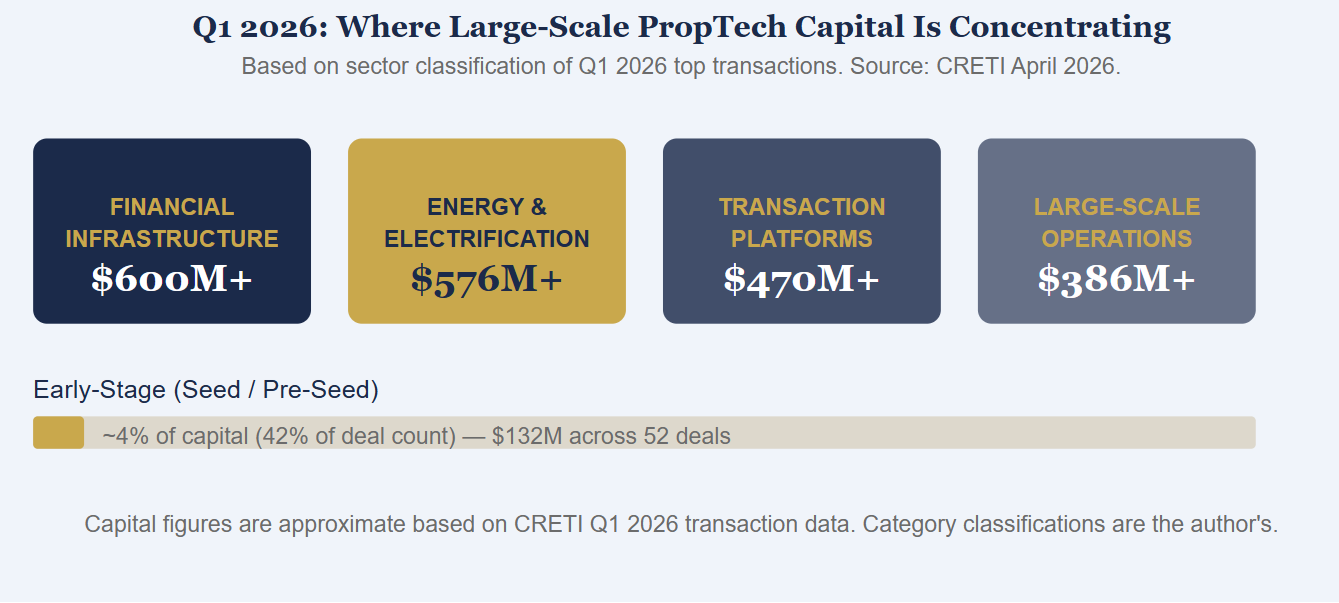
Source: CRETI
The Regional Lens
Why MENA, and Specifically Dubai, Is Emerging as PropTech’s Next Frontier
PropTech was the second-largest startup sector in MENA in 2025, drawing $1 billion across 36 deals, according to Wamda. That figure represents meaningful growth, but it also represents significant under-penetration relative to what the underlying real estate market demands. The UAE PropTech market, valued at approximately AED 2.24 billion in 2024, is projected to nearly triple to AED 5.69 billion by 2030, a compound annual growth rate of approximately 17.5%, according to research published by Dubai IT Consulting in February 2026.
Several structural factors make Dubai a particularly compelling PropTech environment for both founders and investors in 2026. The Dubai Land Department publishes real-time transaction data through platforms like REST and Dubai Now, giving AI and analytics companies access to one of the richest, most transparent property datasets in the world. The Dubai PropTech Hub has set targets to incubate 200+ companies, create 3,000+ jobs, and attract over $300 million in venture capital by 2030. Regulatory clarity from VARA and the DLD has enabled genuine innovation in tokenization: the DLD already partners with Prypco Mint on MENA’s first government-backed tokenized real estate product, allowing fractional ownership from as little as AED 500.
“Property Finder’s $170M Private Equity round in Q1 2026 is the defining MENA PropTech signal of the year. The platform grew UAE core revenues from $30M in 2021 to $117M in 2024, a 300%+ increase in three years, and raised a combined $525M total investment in 2025. It is the first MENA PropTech deal to appear in CRETI’s global top 10 for a quarter. Global PropTech VC firms including MetaProp and Pi Labs are now actively scouting the UAE.”
Sources: FinTech News AE, December 2025; CRETI Q1 2026; Dubai Future District Fund, January 2026
From my vantage point at Sophonos Investments, where we have been allocating into PropTech and adjacent technology categories since 2018, the MENA market in 2026 exhibits a pattern I have seen before in other emerging PropTech hubs: a few anchor companies establishing proof of scale, a government ecosystem creating structural advantages, and global investors beginning to compete for the best early-stage deals. This is the window. The companies that secure the right early-stage backing in 2026 will be the Property Finders of 2030.
The Investor's Framework
What I Actually Look for When Evaluating a PropTech Investment in 2026
After eight years of PropTech investing through multiple cycles, the criteria I use have evolved considerably. The framework I apply at Sophonos Investments in 2026 is shaped by two hard lessons: the 2022 correction taught us how quickly momentum-based PropTech valuations collapse, and the 2025 recovery taught us which categories genuinely compound over time.
Revenue Visibility Over Viral Growth
The single most important shift in PropTech investing since 2022 is the premium placed on recurring, contracted revenue over growth metrics. Companies that survived the correction, AppFolio, Buildium, Dealpath, RentSpree, did so because they had genuine operator retention. Platforms that collapsed (Sonder, Zeus Living, Common) had growth but not unit economics. In 2026, I look for annual recurring revenue with net revenue retention above 100%, which indicates that existing customers are expanding, the clearest sign of genuine product-market fit in a B2B PropTech context.
Alignment With Underlying Real Estate Economics
The best PropTech investments are those where the technology’s value proposition is directly tied to a line item in the real estate P&L, not a feature that is nice-to-have. Energy management software that demonstrably reduces utility costs by 20% sells itself. AI maintenance prediction tools that cut emergency repair costs by 30% renew automatically. Tenant communication apps with no clear ROI connection to NOI get cancelled in the next budget cycle. I invest in the former category exclusively.
MENA-Native or MENA-Ready Product Design
This is specific to our regional mandate at Sophonos, but it is worth articulating. The UAE real estate market has structural characteristics, freehold zones, off-plan dominance, high investor-to-end-user ratio, cash transaction prevalence, that mean a product built for the US market cannot simply be imported. The MENA PropTech companies I back in 2026 are those that have designed for these characteristics from the ground up, not adapted to them as an afterthought.
How much was invested in PropTech in 2026?
Q1 2026 alone saw $3.30 billion invested in PropTech across 125 transactions, a 64% year-on-year increase, according to CRETI. January 2026 recorded approximately $1.7 billion, up 176% versus January 2025. If the Q1 pace holds, 2026 global PropTech investment could exceed $20 billion, above 2025’s $16.7 billion which itself surpassed the pre-pandemic 2019 high of $14 billion.
Which PropTech sectors are attracting the most investment in 2026?
According to CRETI’s Q1 2026 analysis, capital is concentrating in four sectors: financial infrastructure and lending platforms (Kiavi at $350M, Roc360 at $150M), energy and electrification systems (Terralayr at $413M combined), large-scale transaction platforms and marketplaces (Property Finder at $170M), and large-scale operational systems. AI-native PropTech companies as a category grew at 42% annualised in 2025, nearly double non-AI PropTech.
What is the PropTech market size in 2026?
The global PropTech market is projected at $44.59 billion in 2026, with growth expected to reach $104.57 billion by 2034, according to PropTech News (June 2026). In terms of venture investment, $16.7 billion was deployed in 2025 and Q1 2026 is already tracking at a pace that suggests 2026 could exceed $20 billion.
What is the PropTech opportunity in Dubai and MENA?
PropTech was MENA’s second-largest startup sector in 2025, drawing $1 billion across 36 deals (Wamda). The UAE PropTech market is valued at AED 2.24 billion in 2024 and projected to reach AED 5.69 billion by 2030 (CAGR ~17.5%). Dubai’s PropTech Hub targets 200+ companies incubated, 3,000+ jobs, and $300M+ in VC by 2030. Property Finder’s $170M PE round in Q1 2026 was the first MENA PropTech deal to appear in CRETI’s global quarterly top 10.
Is PropTech a good investment in 2026?
PropTech remains a compelling long-term investment category in 2026, but requires sharper selectivity than the 2021 boom era. Capital is concentrating in companies with proven revenue, clear alignment with real estate P&L metrics, and AI-native architectures. Early-stage activity remains active — 52 seed/pre-seed deals in Q1 2026 alone — but median deal sizes are disciplined at $8M, reflecting rational pricing rather than speculative funding.